Archimedes’ Principle – “खरिदार विशेष”
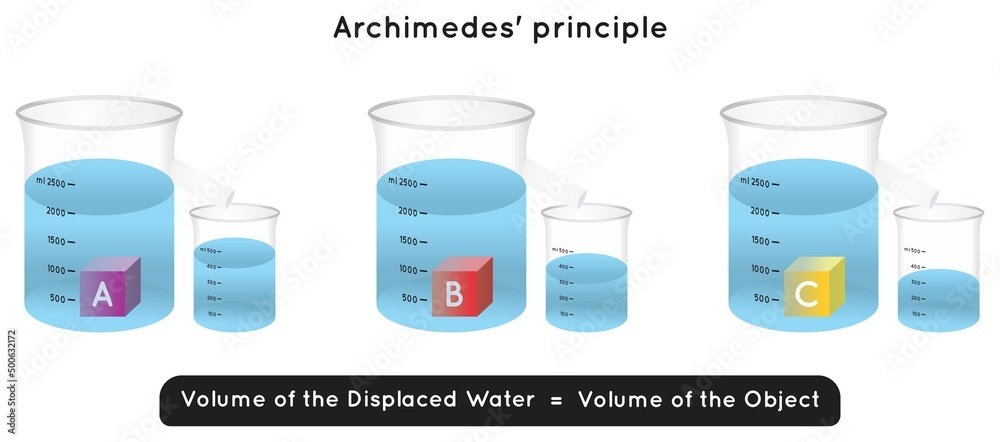
Archimedes’ Principle is a fundamental principle in physics that deals with the behavior of objects immersed in fluids, especially in relation to buoyancy. It was formulated by the ancient Greek mathematician and physicist Archimedes in the 3rd century BC.
The principle can be stated as follows:
“When an object is immersed in a fluid (liquid or gas), it experiences an upward buoyant force that is equal to the weight of the fluid displaced by the object. This buoyant force acts in the opposite direction to the force of gravity, which pulls the object downward.”
Here are some key points to understand about Archimedes’ Principle:
- Buoyant Force: The buoyant force is the force exerted by a fluid on an object that is immersed in it. It is directed upwards and opposes the gravitational force that acts on the object, which tends to pull it downward.
- Displacement: The principle applies to objects that are either partially or wholly submerged in a fluid. The crucial factor is the volume of the fluid displaced by the object.
- Weight of Displaced Fluid: The buoyant force experienced by the object is equal to the weight of the fluid it displaces. This means that the more fluid an object displaces, the greater the buoyant force it experiences.
Mathematically, the buoyant force (F_b) can be calculated using the formula:
F_b = ρ * V * g
Where:
- F_b is the buoyant force
- ρ (rho) is the density of the fluid
- V is the volume of the fluid displaced by the object
- g is the acceleration due to gravity
If the buoyant force is greater than the weight of the object, the object will float. If the buoyant force is less than the weight of the object, the object will sink.
Archimedes’ Principle has many practical applications, such as explaining why ships float, understanding how hot air balloons work, and determining the density of irregularly shaped objects by measuring their buoyancy. It is a fundamental concept in fluid mechanics and has been crucial in various engineering and scientific fields.